



3 NICHD-Funded Randomized Controlled Trials
The Most Rigorous Dyslexia Intervention Evidence Base in K–12

A Different Literacy Intervention for Students Who Have Not Responded to Prior Instruction

1st → 39th
Percentile Gain in Decoding
40%
Exited Special Education
d = 1.8
Effect Size, Phonological Processing
25+ yrs
 Implementation

Supported by three NICHD-funded randomized controlled trials — with documented decoding gains from below the 1st percentile to the 39th and 40% of students exiting special education — NOW! Programs® delivers a speech-to-print structured literacy system for students who have not responded to prior instruction.

Unlike programs that focus primarily on isolated skill instruction, NOW! Programs® integrates decoding, language processing, and comprehension within a unified system designed to improve student outcomes and support reliable implementation in school settings.

What Is a Randomized Controlled Trial in Literacy Research?

NICHD-funded randomized controlled trials (RCTs) demonstrate that intensive, structured literacy intervention can produce significant improvements in decoding, reading accuracy, fluency, and language skills—particularly for students with persistent reading difficulty.

Randomized controlled trials are among the most rigorous research designs used to evaluate whether an instructional approach produces measurable change in student outcomes.

The studies referenced here were funded by the National Institute of Child Health and Human Development (NICHD) and examined both prevention of reading difficulty and remediation of severe reading disabilities under defined instructional conditions.

Instructional Model Overview

Speech-to-Print Literacy Approach

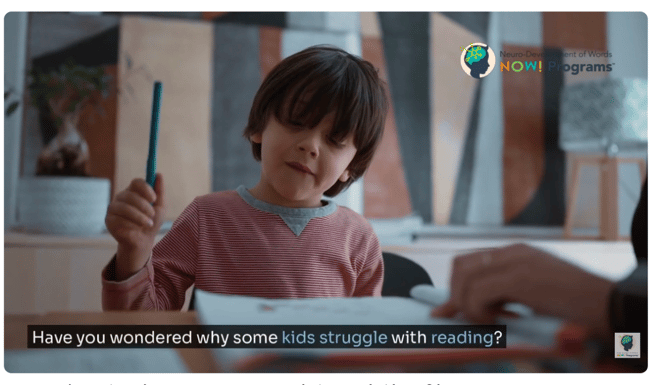
This brief overview highlights a foundational gap often present in students with dyslexia—how speech is seen, heard, and felt before it is connected to written language. When instruction moves to print before these skills are fully developed, students can remain stuck in inaccurate decoding despite prior intervention.
 Child working on writing while developing early literacy skills and reading ability
 

The model integrates decoding, language processing, and comprehension within a unified system—distinguishing it from approaches that focus on isolated skill instruction.
Research in reading development shows that decoding and reading fluency are strong predictors of comprehension, meaning gaps in foundational skills can limit overall reading outcomes.
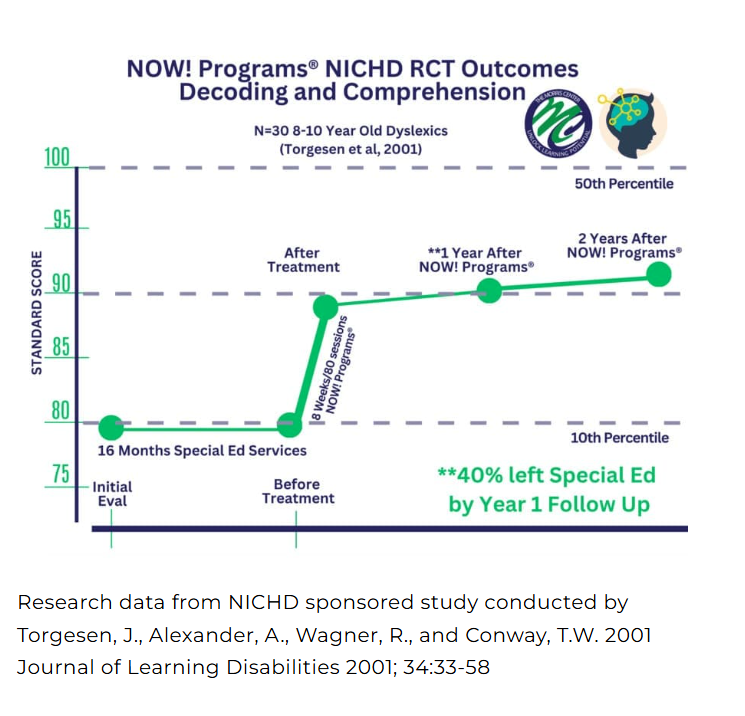
Graph showing student reading gains from an NICHD-funded randomized controlled trial
40%
of students exited special education services following intensive intervention in one study condition
RCT | Prevention

Preventing Reading Failure in Young Children (1999)

Early structured literacy intervention delivered across K–2 in a one-to-one format over multiple years.

  • Students achieved average-range reading performance following intervention
  • Strong gains in phonological awareness, decoding, and word reading skills
  • Substantial reduction in long-term reading failure risk for at-risk students
RCT | Remediation

Intensive Remediation for Severe Reading Disabilities (2001)

Students with severe reading disabilities (many receiving special education services for over a year) received approximately 67.5 hours of intensive one-to-one instruction over ~8 weeks.

  • Decoding skills improved from below the 1st percentile to approximately the 39th percentile
  • Average reading standard scores increased by ~14 points post-intervention and up to ~18 points at follow-up
  • Significant gains in reading accuracy, fluency, and comprehension
  • Results remained stable over time, indicating lasting improvement

These findings demonstrate that even students with long-standing reading difficulties can make accelerated, meaningful gains in decoding, fluency, and comprehension when provided with intensive, well-structured intervention aligned with the underlying processes of reading.


Evidence-Based. Outcomes-Focused.

 Explore the research foundation behind NOW! Foundations for Speech, Language, Reading and Spelling® and the implementation model—or schedule a pilot planning call to evaluate fit for your school system.  

 
Evidence Lineage

Research Came First. Then the Product. In This Industry, That's Rare.

Most literacy intervention programs were commercialized first — then evidence was sought to support the marketing. NOW! Foundations for Speech, Language, Reading, and Spelling® followed the opposite path: the foundational theory was established in 1969, first published in the peer-reviewed Annals of Dyslexia in 1991, then validated in three NICHD-funded randomized controlled trials before any commercial product existed, and only then was it formalized into a scalable program in 2013. For districts making evidence-based purchasing decisions, this sequence is not a footnote. It is the entire argument.

Research-First Model
NOW! Programs®
1
1969 — Theoretical model established (Lindamood, ADD Program)
2
1991 — First peer-reviewed results published in Annals of Dyslexia — before any commercial product existed
3
Pre-commercial — 3 NICHD-funded RCTs completed; peer-reviewed results published
4
2013 — NOW! Foundations for Speech, Language, Reading, and Spelling® formalized as a commercial product
The evidence base predates — and is independent of — every sales conversation.
Scale-First Model
Most Competitors
1
Commercial launch — product released and scaled to market
2
Post-launch studies — evidence sought or funded by publisher after adoption
3
Small-sample studies — e.g., Lexia Core5 primary study: n=116 students; Read 180 avg effect size: d=0.08
Marketing claims are built first; independent verification follows — if at all.
1969 — Theoretical Foundation
Model Established Before Any Commercial Intent
The sensory-cognitive framework underlying NOW! Foundations for Speech, Language, Reading, and Spelling® originates in Lindamood's Auditory Discrimination in Depth (1969) — a research program, not a product launch. The question being asked was scientific: how do phonological processes support reading acquisition?
1991 — First Peer-Reviewed Publication
Validated in Print Before Any Product Existed
Alexander, Andersen, Heilman, Voeller, and Torgesen published results from the ADD program in the Annals of Dyslexia (Vol. 41, pp. 193–206) — documenting statistically significant gains in phonological awareness and analytic decoding in students with severe dyslexia. This was the research community's first peer-reviewed confirmation that the method worked, and it became the pilot data that secured NICHD funding for the randomized controlled trials that followed.
Alexander et al. (1991). Annals of Dyslexia, 41, 193–206. doi:10.1007/BF02648086
Pre-2013 — Independent Validation
Three NICHD-Funded RCTs — Before the Brand Existed
Researchers including Dr. Joseph Torgesen (Florida State), Dr. Ann Alexander, and Dr. Tim Conway conducted three federally funded randomized controlled trials under controlled instructional conditions — publishing peer-reviewed results with documented effect sizes. The program had no brand name at this stage.
2013 — Commercial Formalization
NOW! Programs® Created to Scale What Already Worked
Only after the evidence was established did NOW! Foundations for Speech, Language, Reading, and Spelling® emerge as a product — structured to translate the validated model into school-implementable systems with fidelity protocols. The program exists to deliver an evidence-based method at scale, not to generate evidence for a product that already needed selling.
What this means when your district is making a purchasing decision

When a district adopts NOW! Programs®, they are not funding the development of an evidence base that doesn't yet exist. The evidence was produced independently, before commercialization, using federal research funding — not publisher budgets. That distinction matters when evaluating whether outcome claims are marketing or science.

Competitors with smaller effect sizes (Lexia Core5: d=0.23; Read 180: d=0.08 average) generated much of their evidence after achieving commercial scale — often through publisher-funded or low-sample studies. NOW! Programs®' three NICHD RCTs predate the brand by years and were conducted by independent university researchers with no commercial stake in the outcome.

 
Comparing Intervention Approaches

How NOW! Programs® Differs from Common Literacy Interventions

When students are not making adequate progress, differences in evidence base, instructional design, and implementation fidelity become the deciding factors — not brand names.

Effect sizes sourced from Torgesen et al. (2001); Bowden (2022); and published Lexia and Read 180 research summaries.

Evidence
NICHD-Funded Randomized Controlled Trials
3
NOW! Programs®
NICHD-funded
Wilson / OG
Not published
Lexia Core5
1 study (n = 116)
Read 180
5 studies
Primary Effect Size
d = 1.8
NOW! Programs®
Wilson / OG
Lexia Core5
d = 0.23
Read 180
d = 0.08 avg
Documented Decoding Gain (RCT)
1st → 39th
Percentile
NOW! Programs®
No equivalent published decoding gain documented for Wilson/OG, Lexia Core5, or Read 180 at this scale.
Sp. Ed. Exit Rate — Documented in RCT
40%
NOW! Programs®
No comparable special education exit rate published for comparison programs.
Continuous School Implementation
25+ yrs
Einstein School, since 1999
NOW! Programs®
No dedicated public dyslexia charter school equivalent documented for comparison programs.
Program Design
Student Fit
NOW! Programs®: Non-responders to prior intervention; severe dyslexia
Wilson / OG
Language-based learning disability
Lexia Core5
Broad populations
Read 180
Struggling readers, upper elementary+
Instructional Model
NOW! Programs®: Speech-to-print (oral-articulatory foundation)
Wilson / OG
OG print-to-speech structured literacy
Lexia Core5
Adaptive digital progression
Read 180
Blended software + teacher-led
Fidelity Monitoring
NOW! Programs®
Centralized Managed Model
Dedicated implementation specialists, ongoing fidelity coaching, structured data-review cycles, and instructional protocols aligned to the conditions used in the NICHD RCTs.
Wilson / OG
Practitioner-trained; site-managed. No centralized fidelity oversight after certification.
Lexia Core5
Platform tracks usage data. Instructional fidelity is school-managed; no specialist oversight.
Read 180
Initial publisher PD provided. Ongoing fidelity is school-managed after rollout.
Tier Coverage
NOW! Programs®: Tier 2, Tier 3, and Intensive 1:1
Wilson / OG
Tier 3 primarily
Lexia Core5
Tier 1–2 primarily
Read 180
Tier 2–3

Effect size d = 1.8 sourced from Bowden (2022), University of South Carolina doctoral dissertation, CTOPP-2 Elision measure. Lexia Core5 d = 0.23 and Read 180 average d = 0.08 reflect reported outcomes from each program's published research summaries. Wilson/OG RCT effect sizes are not published in peer-reviewed form. "—" indicates no comparable published data available.

District Decision Consideration

For districts reviewing non-response, the key question is not whether programs share similar literacy terminology, but whether they differ in the instructional conditions most likely to change student trajectory.

This distinction becomes especially important when evaluating next steps for students who have not responded to current intervention.

 
Implementation Model

The RCT Results Were Produced Under Managed Conditions. So Is Every Engagement.

The documented outcomes from the NICHD trials — decoding gains from below the 1st percentile to the 39th, 40% of students exiting special education — were not produced by handing schools a curriculum and stepping back. They were produced under controlled instructional conditions with specialist-led delivery and fidelity oversight. NOW! Programs® replicates those conditions in every district engagement through a centralized managed model. You are not purchasing a program. You are engaging an implementation system.

1
Dedicated Implementation Specialists
Each engagement is supported by NOW! Programs® certified instructors and monitored by a Quality Control Team. QC monitors and gives feedback to instructors for instructional quality across the full engagement, not just the launch.
2
Ongoing Fidelity Coaching
Instructional fidelity is monitored continuously — not evaluated in a single walkthrough. Quality Control observes sessions, provides direct coaching, and flags drift from the model before it affects student outcomes.
3
Structured Data-Review Cycles
Student progress data is reviewed on a defined cadence. When students are not on trajectory, the model provides a structured process for identifying whether the issue is fidelity, pacing, grouping, or student fit — before the problem compounds.
4
RCT-Aligned Instructional Protocols
The protocols governing session structure, instructional sequence, and pacing are derived directly from the conditions used in the NICHD trials. This alignment is the mechanism by which research outcomes transfer to your district's students.
5
District-Level Progress Reporting
Special education directors and administrators receive structured progress summaries — not anecdotal updates. Reporting covers student trajectory, fidelity indicators, and cohort-level outcome trends across each intervention cycle.
Why this differs from how most programs are delivered
Wilson / OG
Trains practitioners to deliver the model and certifies them — but delivery after certification is practitioner-managed. There is no centralized mechanism for monitoring ongoing instructional fidelity across a district's intervention cohort.
Lexia Core5
The platform monitors student usage and progress within the software. Instructional fidelity — how teachers facilitate the program, group students, and respond to non-response — is managed entirely at the school level with no specialist oversight.
Read 180
Publisher provides initial professional development and setup support. Ongoing delivery fidelity is school-managed, with teacher coaching and data review left to building-level administrators and instructional coaches.
The fidelity gap is where evidence-based programs fail in practice

Research consistently shows that the primary reason evidence-based interventions fail to replicate published outcomes in schools is implementation fidelity — not the model itself. Programs delivered with low fidelity produce low outcomes, regardless of what the RCT showed.

The managed fidelity model is how NOW! Programs® closes that gap. It is not a support add-on. It is the delivery mechanism — and it is why the outcomes documented in research are reproducible in your schools.

NOW! Programs® Instructional Model

Five Pillars of the NOW! Foundations for Speech, Language, Reading, and Spelling® Structured Literacy Model

NOW! Foundations for Speech, Language, Reading, and Spelling® is built around a speech-to-print, structured literacy model designed for students who are not making adequate progress with standard reading intervention. For district leaders, these five pillars clarify the instructional conditions that make this approach different—especially in cases involving dyslexia, persistent decoding difficulty, and long-term intervention need.

Rather than describing literacy support in broad terms, this model defines the elements schools can evaluate directly: instructional design, intensity, sequencing, foundational skill development, and the goal of independent reading proficiency.

01
Speech-to-Print Foundation
Instruction begins with speech-sound processing, articulation, and phonological awareness before mapping to print. This design differs from print-first intervention by targeting the language foundations that often underlie persistent reading difficulty.
Low High
02
Intensity That Tests True Student Response
Students with significant reading difficulty often require more than added exposure. They need enough instructional intensity, consistency, and time to determine whether trajectory changes under clearly defined intervention conditions.
03
Explicit, Systematic & Cumulative
Instruction is explicit, systematic, and cumulative, with carefully sequenced teaching that builds decoding, spelling, and language skills in a defined progression. That structure supports fidelity, replication, and clearer evaluation of student response.
FOUNDATION
04
Build the Foundation First
The model develops foundational speech and language skills first, rather than assuming they are already in place. For students who have not responded to prior intervention, this helps address underlying gaps before expecting higher-level literacy performance.
05
Proficiency & Independence
The goal is accurate, fluent, and independent reading—not indefinite dependence on intervention, accommodations, or assistive technology when stronger foundational reading outcomes may still be possible.

Together, these five pillars define a district-reviewable instructional model grounded in speech-to-print design, structured delivery, and intervention intensity. They describe not just what NOW! Programs® teaches, but the conditions under which student response can be more clearly evaluated.

For schools reviewing students who are not progressing with current literacy support, this framework helps clarify whether the intervention itself is materially different in design, intensity, and implementation—before longer-term placement and service decisions are made.

School staff selecting literacy intervention resources for students with reading difficulties and dyslexia

What Research Shows About Literacy Intervention

It’s not just whether intervention is provided — it’s how it is designed and delivered.

Instructional intensity and structure are primary drivers of outcomes. Research in structured literacy and intervention studies shows that student progress is influenced by how instruction is delivered—including intensity, explicitness, and sequencing—not simply whether intervention is present.

Students with persistent reading difficulty can demonstrate measurable response under different conditions. Students who do not respond to standard instruction may show significant gains when instructional intensity, structure, and duration are adjusted, highlighting the importance of evaluating response under appropriate intervention conditions.

Program selection alone does not determine effectiveness. Outcomes depend on implementation quality, instructional fidelity, intensity, and sufficient duration—not just adopting a specific curriculum or increasing instructional time.

Limited progress may reflect instructional conditions, not fixed student capacity. When students are not improving, it may indicate that the intervention conditions have not yet been sufficient to produce change, rather than confirming a lack of potential.

Bottom line: Before making long-term instructional, placement, or funding decisions, student response should be evaluated under clearly defined, sufficiently intensive, and consistently delivered intervention conditions.

 
NOW! Programs® Supports All Five Pillars of Reading

NOW! Programs® aligns with the five pillars of reading through an integrated four-program structured literacy system. Foundations directly supports phonological awareness, phonics, and fluency, while Mental Imagery and Grammar & Writing strengthen vocabulary and comprehension through language-based instruction.

Math Concept Imagery extends vocabulary and comprehension through the language of mathematics, supporting reasoning and problem solving as part of the broader system.

Phonological awareness
Phonics
Fluency
Vocabulary
Comprehension
Group of students receiving targeted reading support as part of literacy intervention and MTSS framework

How This Approach Differs from Standard Literacy Intervention

Many literacy interventions share similar terminology and instructional components. Differences become most relevant when students are not demonstrating adequate response to existing support.

This approach is informed by multiple NICHD-funded randomized controlled trials (RCTs) examining both prevention and remediation of reading difficulty, providing a high level of research context for instructional design decisions in intensive reading intervention.

It is based on a speech-to-print, oral-articulatory instructional model that integrates speech, language, reading, and spelling—targeting underlying linguistic processes that are not systematically addressed in print-first intervention approaches.

The model has been developed through long-term clinical application and classroom implementation, including use in specialized school settings serving students with dyslexia and persistent reading difficulty.

For schools evaluating students who are not making adequate progress, these distinctions influence whether a student demonstrates measurable response under more intensive and clearly defined instructional conditions.

Read more: Research depth and implementation context

This instructional model is associated with three multi-year NICHD-funded randomized controlled trials, a relatively uncommon level of evidence within literacy intervention research.

It reflects more than five decades of clinical and instructional development focused on students with persistent reading difficulty and dyslexia.

Implementation has included use in specialized public school environments, providing context for how the model functions under real-world instructional conditions, including intensive intervention settings.

What These Findings Mean for Schools and Literacy Intervention

For many schools, the challenge is not identifying students who are struggling. It is determining how to respond when students do not demonstrate adequate response to existing intervention.

Are students demonstrating measurable response to intervention, or continuing on the same trajectory despite current support?

Does the current intervention provide a sufficient test of student potential under more intensive, structured instructional conditions?

What steps are taken when students do not respond—before long-term placement or service decisions are made?

How do intervention intensity, instructional structure, and implementation fidelity influence whether a student’s trajectory changes?

These questions are not only instructional. They directly affect resource allocation, staffing, and long-term district costs.

When intervention does not change trajectory
Students may continue to require increasingly intensive services over time, including Tier 3 intervention, special education support, and extended accommodations. For districts, this can result in higher long-term instructional costs, increased staffing demands, and sustained resource allocation without a change in student trajectory.

The practical question for schools is not simply which program to use. It is whether the current approach is providing a clear and sufficient evaluation of student response under appropriate instructional conditions—before that trajectory becomes more difficult and more costly to change.

Book used to represent literacy learning, reading improvement, and intervention for students with dyslexia
What the Data Shows

Most Students Who Enter Special Education Never Leave

According to the 2024 Annual Report to Congress on IDEA, the vast majority of students who receive special education services do not return to general education — they age out, receive modified credentials, or drop out entirely.

National Average
8.2%
of special education students (ages 14–21) transferred back to regular education
Source: U.S. Dept. of Education, 2024 Annual Report to Congress on IDEA, Exhibit 39 (2021–22 data)
NOW Programs® Students
40%
exit special education and return to general education
Nearly 5× the national transfer-to-regular-education rate
Where students who exit IDEA Part B actually go (2021–22)
Graduated w/ diploma
 
52%
Moved, continuing SPED
 
21%
Dropped out
 
11%
Received a certificate
 
6.6%
Transferred to gen. ed.
 
8.2%
U.S. Dept. of Education, 2024 Annual Report to Congress on IDEA, Exhibit 39

Graduating with a diploma or certificate does not mean a student exited special education — it means they aged out of the system. Only 8.2% of students who leave IDEA services actually return to regular education. For the other 91.8%, special education became a permanent track. NOW Programs® was designed to change that trajectory — before it becomes permanent.

 When Students Don’t Respond to Literacy Intervention: What Should Districts Do Next? 

 A structured approach to evaluating instructional effectiveness, student response, and financial impact before long-term service commitments increase. 

Pilot options starting at $20,000 annually (4 students), with scalable cohort models for broader evaluation

A structured financial model for evaluating Tier 3 cost exposure and long-term service impact

Break-even analysis showing how a small number of students demonstrating response may offset pilot cost within one year

The brief outlines how districts can evaluate a low-risk pilot within a defined cost and timeframe, and compare it to the long-term financial exposure associated with Tier 3 placement at the cohort level.

Designed for superintendents, CFOs, and special education leaders, this document provides a data-driven framework for evaluating intervention effectiveness, financial risk, and resource allocation using district-specific inputs.

This is a fixed-cost, one-year evaluation with defined parameters and a clear exit—not an open-ended program commitment.

Download District Financial Brief & Pilot Model →
Includes cost modeling, pilot options, break-even analysis, and district evaluation framework

This download includes:

• District financial model and cost scenarios
• Break-even and ROI framework
• Flexible pilot structures (small-scale to cohort-level)

Immediate access. Review independently to determine whether further analysis or discussion is warranted.

The financial risk is not the pilot. It is the cost trajectory already in place when student outcomes do not change under current intervention.

 
Investment Perspective

Evaluating Early Intervention Investment vs. Long-Term Service Cost

When students do not receive sufficient intervention early, districts may experience increasing long-term costs associated with sustained Tier 3 services and special education support.

Example Pilot Investment (Scalable)
Entry: 4 students ($20,000)
Cohort model: 20 students
Up to $100,000
Typical Tier 3 Cost Progression
Year 1: evaluation + services
Ongoing annual support
~$25,000 (Year 1)
~$150,000–$200,000+ cumulative

Illustrative threshold: Under commonly observed cost assumptions, a pilot of approximately 20 students may reach break-even within one year if approximately 4 students (20%) demonstrate sufficient response to avoid Tier 3 placement. Long-term financial impact increases as more students demonstrate response.

These figures are illustrative and should be validated using district-specific data. The key consideration is not the pilot cost alone, but whether current intervention is providing a clear opportunity to change student trajectory before long-term costs accumulate.

Instructional Gaps in Literacy Intervention

Why Students May Not Respond to Reading Intervention

Persistent reading difficulties are often associated with misalignment between instructional approach, intensity, and student need. In many cases, inconsistent implementation, insufficient instructional dosage, or limited focus on underlying language and phonological processing can reduce measurable response within MTSS and tiered intervention frameworks.

Students struggle with reading when instruction does not address underlying language and speech-sound processing deficits
1 Reading outcomes are closely connected to underlying language processing, including phonological and speech-sound awareness. 
Students receive repeated reading instruction that uses the same ineffective method instead of a new approach
2 For some students, changes in instructional design—not just increased exposure—may be necessary to produce measurable response.
Gaps in phonological processing and speech-to-print integration prevent students from developing reading proficiency
3  Explicit connections between speech, language, and print are often necessary for foundational reading development. 
Inconsistent classroom implementation of reading instruction leads to uneven student outcomes and lack of progress
4  Consistent implementation is a key factor in evaluating student response to intervention. 
Instructional Conditions Summary

Instructional Conditions Influence Student Response

Student outcomes are shaped by the interaction of instructional design, intensity, duration, and implementation fidelity. When these conditions are not aligned, students may not demonstrate measurable response—even when intervention is in place.

Instructional Design
Intensity
Duration
Implementation Fidelity
 
Flexible Service Paths

A Multi-Pathway Literacy Intervention Framework for Schools and Districts

Schools and districts often need more than one intervention pathway. These service options are designed to support students at different levels of reading difficulty, from Tier 2 and Tier 3 small-group intervention to intensive one-to-one instruction for students with the most significant needs.

Service Path 1

Tier 2 and Tier 3 Small-Group Intervention

Designed for students who require more than core instruction and are not demonstrating adequate response to current literacy intervention.

  • Supports students with persistent decoding, spelling, and reading difficulties
  • Fits intervention blocks, district pilot structures, and school-based implementation planning
  • Provides a structured option for evaluating response under more intensive instructional conditions
Service Path 2

Intensive 1:1 Reading Intervention

Designed for students with severe dyslexia and the most significant reading difficulties who require a more intensive level of instructional support.

  • Provides one-to-one instruction for students with the highest level of reading need
  • Supports districts in evaluating response for students at greatest risk of long-term intensive service dependence
  • Offers a stronger intervention pathway when prior literacy support has not changed student trajectory

Service selection should be based on student response, level of need, and the instructional intensity required to produce measurable change.


Documented Outcomes & School Evidence

What Schools Document, and What Educators Observe

Research provides context for this instructional approach. The two resources below document how it performs in practice — including standardized assessment outcomes, student case examples, and school-based implementation.

For Literacy & Special Education Directors

Student Outcomes: From Assessment Gains to Real Transformation

This resource includes documented student case examples alongside school-reported gains on standardized reading and phonological processing measures. One example highlights a student who progressed from significant reading and writing difficulty to independently authoring a published book, supported by a family interview and video. Additional examples include writing development and longer-term academic pathways.

Review Documented Student Outcomes →

For CAOs, Implementation Teams & Finance Directors

Implementation Evidence: Effect Sizes, Program Structure & Partnership Model

Effect Size d = 1.8 +28.6 Percentile Gain Score: 84 → 102

Standardized outcome data from an independent study documented a +28.6 percentile gain on phonological processing (effect size d = 1.8) and a Phonological Awareness Composite standard score improvement from 84 to 102. These results are presented within the context of study design, instructional conditions, and implementation structure. This page also outlines the four-program instructional system, managed implementation model, phased partnership pathway, and funding options including IDEA, Title I, and state dyslexia intervention allocations.

Review Implementation Evidence & Effect Sizes →
 

Two educators describe what they observed during implementation:

"

We've observed clear improvements in reading fluency, especially during oral reading. One student shared that reading now feels less effortful, and that change was reflected in classroom performance. The student progressed from fifth-grade to seventh-grade reading passages while meeting benchmarks.

Johnston Community School District Logo

Jenny Gray

Special Education Teacher, Johnston City, IA Public Middle School

From Jenny Gray's Cohort

Three secondary students entered intervention multiple years below grade level. After five months, mid-year data showed accelerated growth:

Student 1

2.0 → 3.2

Grade Equivalent

+1.2 years

Student 2

3.7 → 5.0

Grade Equivalent

+1.3 years

Student 3

1.7 → 3.2

Grade Equivalent

+1.5 years

Areas of focus: phonological processing, sound–symbol knowledge, decoding accuracy, and foundational reading skills.

"

Most impressively, students are now actively applying the program's principles across the broader curriculum, showing growing confidence and self-assurance throughout the cohort.

Ambleside School Logo

Emmy Lilholt

Teacher and Compliance Manager, Ambleside, Ocala, FL Private Elementary School

These outcomes illustrate how student response may change when instructional intensity, structure, and phonological processing are aligned under consistent implementation conditions.

Schedule a District Review Conversation

Review implementation options, pilot structures, and evaluation considerations with our team.


Sustained School Implementation Since 1998

The Einstein School - A Long-Term School Implementation

Beyond controlled research and current classroom outcomes, this approach has demonstrated long-term sustainability in a real school setting. Since 1999, The Einstein School in Gainesville, FL, a tuition free charter school, has implemented this instructional approach to serve students with dyslexia and language-based learning differences within a full academic environment.

Students at The Einstein School reading independently after instruction with NOW! Programs®, demonstrating improved literacy outcomes in reading and spelling.

Students reading independently—an outcome consistently observed following structured, research-based literacy instruction.

Designed for students who require intensive, research-based literacy instruction, the Einstein School provides a unique example of sustained implementation—where the same approach has been used consistently over time, not as a short-term intervention, but as a foundational instructional model. Learn more about The Einstein School

What this means for schools: This is not a newly adopted or short-term model. It is a research-based approach that has been implemented, sustained, and trusted within a dedicated school setting for more than two decades.

For administrators and educators, this long-term use provides an additional layer of confidence—demonstrating that the approach is not only effective in controlled research and current classrooms, but also durable, scalable, and sustainable over time.

 
Students showing confidence and engagement during dyslexia intervention and reading skill development

Frequently Asked Questions

These questions reflect the issues district leaders, special education teams, and literacy administrators often raise when reviewing intervention evidence, student fit, and implementation options.

How is NOW! Foundations for Speech, Language, Reading, and Spelling® different from Wilson Reading System, Lexia Core5, or Read 180?
The primary differences are the instructional model, the student population, and the depth of the research base. NOW! Foundations for Speech, Language, Reading, and Spelling® is associated with NICHD-funded randomized controlled trials and uses a speech-to-print instructional approach that begins with oral-articulatory awareness before mapping sounds to print. By comparison, Wilson Reading System, Lexia Core5, and Read 180 use different instructional mechanisms and serve somewhat different implementation purposes within district literacy systems. For districts reviewing students who are not responding to prior intervention, these differences in instructional design, intensity, and evidence base become especially important.
What do the NICHD randomized controlled trials actually show?
The primary NICHD-funded randomized controlled trial referenced on this page (Torgesen et al., 2001) enrolled 60 children with severe reading disabilities who received intensive one-to-one instruction over 8 weeks. The study reported large gains in generalized reading skills, with effects remaining stable at a two-year follow-up. A second NICHD-related study (Torgesen et al., 1999) examined early intervention across kindergarten through Grade 2 and reported that targeted phonological processing instruction could reduce reading failure for many at-risk students. Both studies are linked on the Research Evidence page for district review.
Can this program serve students with IEPs or students already in special education?
Yes. The research base referenced for NOW! Foundations for Speech, Language, Reading, and Spelling® includes students with severe reading disabilities, including students receiving special education services. In practice, the program may be appropriate for students with IEPs identifying dyslexia, specific learning disability in reading, language-based learning disability, or persistent reading challenges that have not responded to prior intervention. The intensive one-to-one service path is intended for students at the highest-need end of the continuum.
How do school districts typically fund this program?
Districts commonly explore funding through IDEA Part B, Title I, and state literacy or dyslexia intervention allocations. Some districts also consider implementation through a defined pilot budget line. For finance and district leadership teams, the relevant question is often whether pilot cost can be evaluated against the existing long-term cost trajectory of students requiring intensive services.
Is NOW! Foundations for Speech, Language, Reading, and Spelling® a Science of Reading program?
Yes. NOW! Foundations for Speech, Language, Reading and Spelling® is aligned with the body of research commonly described as the Science of Reading, including research on phonological processing, structured literacy, and explicit instruction in reading development. What distinguishes the model is its speech-to-print instructional mechanism and its use of oral-articulatory awareness as part of the pathway to print.
What is the difference between Tier 1, Tier 2, and Tier 3 literacy intervention?
Within an MTSS (Multi-Tiered System of Supports) framework, Tier 1 is core classroom instruction for all students, Tier 2 is supplemental small-group intervention for students who need additional support, and Tier 3 is intensive, individualized intervention for students with significant reading difficulty who have not responded adequately to earlier support. NOW! Foundations for Speech, Language, Reading, and Spelling® may be implemented as both a small-group intervention pathway and an intensive one-to-one option for students with more severe reading needs.
What is dyslexia intervention?
Dyslexia intervention is structured, explicit reading instruction designed for students with persistent difficulty in phonological processing, decoding, spelling, and fluent word recognition. Effective intervention addresses the underlying language processing challenges associated with reading difficulty and is typically delivered with sufficient intensity, systematic sequencing, and progress monitoring to evaluate measurable student response.
What does NICHD-funded research mean for district decision-makers?
NICHD-funded randomized controlled trials represent a rigorous form of educational research because they are designed to isolate the effect of instruction from other variables. For district leaders evaluating literacy intervention, this type of evidence may carry greater weight in board-level, legal, and state accountability discussions than less controlled forms of evidence.
Why is intervention intensity important for students with dyslexia?
Students with dyslexia and persistent reading difficulty often require more intensive instruction than general classroom reading instruction provides. Research and practice both suggest that session frequency, duration, and total instructional hours can influence whether measurable response occurs. Without sufficient instructional intensity, it may be difficult to determine whether a student's trajectory is changing or whether the intervention condition itself has been insufficient.
How is a literacy intervention pilot typically structured for a school district?
A district literacy intervention pilot is typically structured with a defined student cohort, fixed cost, set duration, and pre-established outcome criteria. This allows district leaders to evaluate student response under a clear instructional condition before deciding whether broader implementation is warranted.

These definitions reflect commonly used terms in dyslexia research, literacy intervention, and MTSS frameworks.

Key Terms in Dyslexia and Literacy Intervention Research

What Is Dyslexia?

Dyslexia is a language-based reading disorder that affects accurate and fluent word recognition. It is commonly associated with difficulty in phonological processing, which impacts decoding, spelling, and reading fluency. Dyslexia can occur even when students receive appropriate instruction and have average or above-average reasoning ability.

What Is Literacy Intervention?

Literacy intervention is targeted, structured reading instruction for students who are not making adequate progress with core classroom teaching. Within MTSS and RTI frameworks, intervention becomes increasingly explicit, systematic, and intensive as student need increases.

What Is a Randomized Controlled Trial (RCT)?

A randomized controlled trial (RCT) is a research design that compares outcomes between an intervention group and a control group. Because participants are randomly assigned, RCTs are considered one of the most rigorous methods for determining whether an instructional approach causes measurable improvement.

What Is Instructional Dosage?

Instructional dosage refers to the total amount of time a student receives intervention, typically measured in hours or sessions. Research shows that dosage—along with intensity and consistency—can influence whether students demonstrate measurable gains in reading.

What Is Phonological Processing?

Phonological processing is the ability to recognize, remember, and manipulate speech sounds. It is a core component of reading development and is strongly associated with decoding, spelling, and early literacy skills.

What Is Response to Intervention (RTI)?

Response to Intervention (RTI) is the degree to which a student’s skills improve when provided with targeted instruction under defined conditions. It is commonly used within MTSS frameworks to evaluate whether students are responding adequately to intervention or require more intensive support.

What This Dyslexia Intervention Research Page Covers

This page is designed for school and district leaders reviewing students who are not making adequate progress with current literacy instruction, dyslexia intervention, or reading support within MTSS and Tiered intervention frameworks.

What dyslexia intervention research shows about intensive, structured literacy instruction for students with persistent reading difficulty

What NICHD-funded randomized controlled trials (RCTs) found and why that level of research matters when evaluating literacy intervention claims

How this instructional model differs from common literacy interventions used with struggling readers and students with dyslexia

What these findings may mean for schools and districts evaluating next-step intervention, service decisions, and student response when current trajectory is not changing

 NOW! Programs® improves outcomes and reduces long term costs. 
Most districts begin with a pilot to evaluate student response and implementation fit.

No commitment required. Designed for district leaders evaluating intervention effectiveness, implementation, and cost.
NOW! Programs® logo

A Proven Option for Students Not Responding to Intervention

Built on research. Sustained in classrooms. Designed for students who need a different path.

📞 (352) 275-5778